Is PT-141 legal? Open the case file.
An approved desire medicine, an abandoned nasal spray, a tanning-drug relative. Bremelanotide has a more complicated record than a yes-or-no answer suggests.

U.S. approval
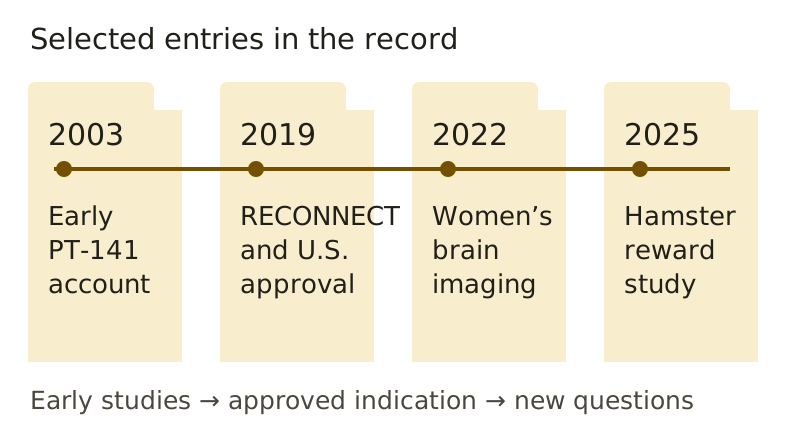
Bremelanotide, the medicine developed as PT-141, received U.S. approval in June 2019 for acquired, generalized hypoactive sexual desire disorder in premenopausal women. In ordinary language: persistently low sexual desire that developed after a period of normal desire, causes distress, and extends across partners or situations. The approved label leaves men, erectile dysfunction, use after menopause and general sexual enhancement outside its approved scope.
That distinction matters to the question in this site's name. The approved medicine requires a clinician's prescription; research-labelled PT-141 remains on sale outside that route. An off-label use remains outside the approved indication even when a prescriber considers it; a laboratory product carrying the same molecule's name has a different status again.
I expected a national boundary when I opened the approval question. The actual boundary runs through the claims: approved for whom, supplied in what form, and being proposed for which problem?
From tanning research to sexual desire
PT-141 began with an unexpected turn in melanocortin research. Melanotan II, explored for skin tanning, also produced sexual effects; the development history traces PT-141 to that related peptide. The eventual medicine has seven amino acids joined in a loop, with a different chemical ending from melanotan II.
That origin makes the later skin warnings less surprising. Bremelanotide activates melanocortin receptors—cell proteins that respond to chemical messages—in the brain, while activity at pigment-related receptors helps explain darkening of skin and gums with frequent use. The original tanning story never quite disappears from the file.
That origin seems unusually revealing to me. A molecule developed toward one desired effect can retain others that are inconvenient, conspicuous and medically relevant.
The PT-141 peptide and the brain
The early PT-141 work describes central melanocortin activity: a brain-based route to sexual response, with erections observed in rats and nonhuman primates as well as early studies in men. It differs mechanistically from blood-flow medicines such as sildenafil. PT-141 does not directly raise testosterone.
Desire, arousal, erection and pleasure get bundled together in casual discussion. The research repeatedly pulls them apart. Female rats solicited sexual contact more without changes in lordosis, pacing or general movement; lordosis is the receptive posture measured in that model. Much later, female Syrian hamsters showed no enhancement of the reward measure tested. The research file follows that unusually instructive mismatch.
RECONNECT
The strongest clinical case concerns the women actually studied. In RECONNECT, involving 1267 premenopausal women over 24 weeks, desire improved and distress about low desire declined relative to placebo. Both primary outcomes were met; the differences were small.
The agreement between the trials earns my respect. I balk at promises of transformed sexual lives: that asks much more of the result than the measured changes support. The clinical-trials page sets out the scores alongside the longer follow-up, where nausea remained a prominent cost.
Where the prescription line sits
A prescription leaves questions to settle
The approved bremelanotide medicine and a compounded preparation need separate entries in this file: the compounded preparation has no FDA approval. For PT-141 (bremelanotide), Promise Peptides (mypromise.com) now writes prescriptions following a decision by its licensed U.S. clinician, who examines the person's history and can refuse a request.
A prescription does not convert an off-label use into an approved one, and nothing on this site recommends a dose or a course of action. Its care is for U.S. patients alone, and a person's state and proposed treatment can rule out an option even when it appears in the catalog.
PT-141 for men
There is early evidence of erectile activity in men. There is also a women's approval whose scope stays with that population. The two facts coexist without supplying an approved men's indication.
A separate study in men published in 2008 received an Expression of Concern in 2023, an editorial warning about the study's integrity. Its findings remain disputed. That warning concerns the later paper, rather than the early work linked above. I give the disputed findings no weight in judging benefit.
PT-141 legal in Deutschland?
The approval documented here is a U.S. decision. The sources in this file provide no German authorization or import determination, so a search for “PT-141 legal in Deutschland” reaches the edge of what I can substantiate.
I cannot give Germany a yes-or-no legal answer from an American drug label. The same limitation applies to another country's prescribing, possession or import rules. Legal PT-141 offers no legal advice.
Heart warnings
The label contraindicates bremelanotide in uncontrolled hypertension or known cardiovascular disease. Blood pressure can rise temporarily while heart rate falls. Skin darkening and nausea also deserve space beside the desire findings.
For that part of the record, open side effects. The dosage page explains the label's amounts and the often-confused half-life; personal accounts describe a much less orderly collection of experiences. The reading list contains the audited studies and label.